
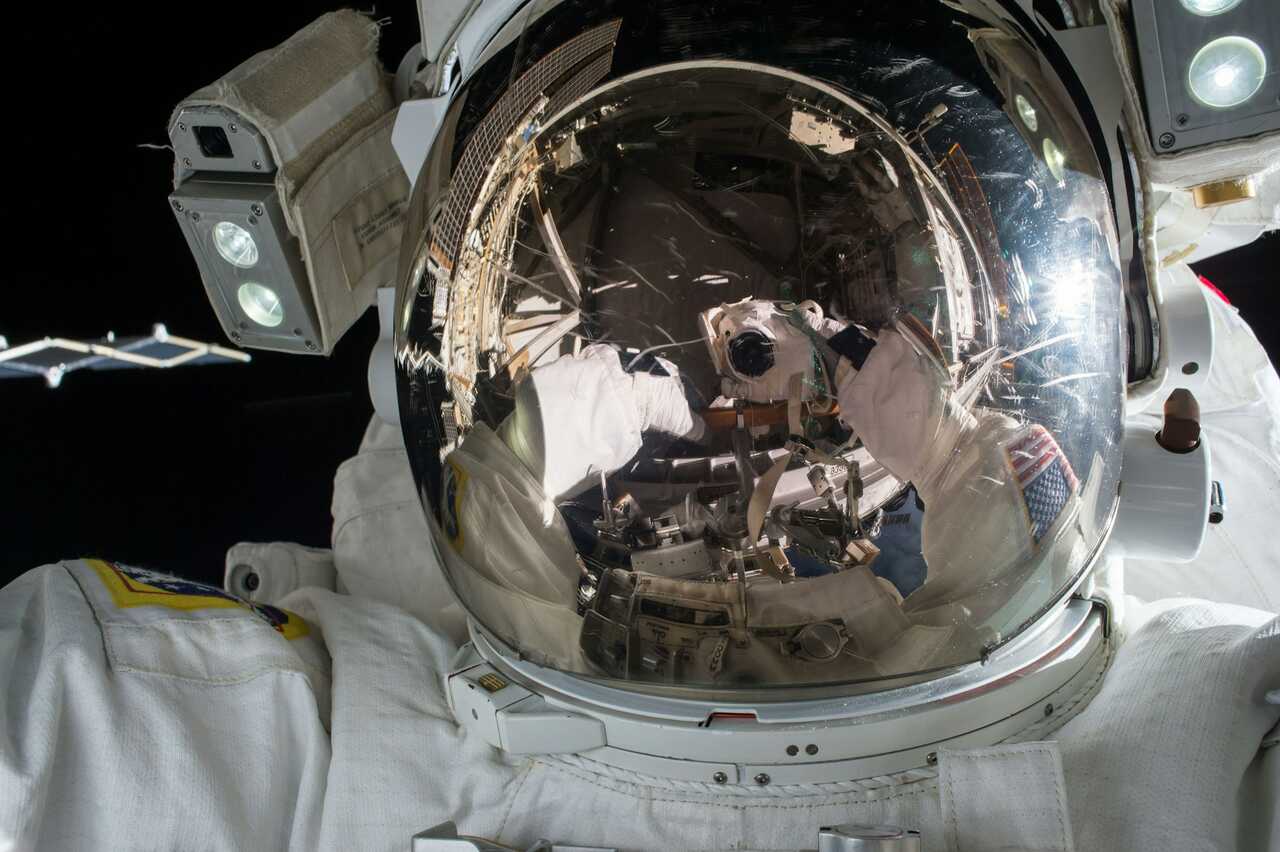
Sleeping in space seems to be quite uncomfortable, but many people wonder why astronauts tie their arms while sleeping.
The scientists working on the International Space Station (ISS) stay there for months, so getting good sleep in zero gravity is crucial for their well-being in space.
But to sleep in space, you need to stay upright. According to Rachel Jansen, a NASA scientist who studies spaceflight, astronauts “don’t have the sensation of lying in bed with a blanket applying some kind of pressure.”
“They just float. So astronauts choose what works best for them. They attach themselves to one of the surfaces—and that can be anywhere, because there’s no up or down,” she told The Washington Post.
“The resting posture in space is like a zombie pose, where the arms involuntarily rise to shoulder height and just float there,” she added, saying that some people “tie their arms” to prevent the zombie pose.
Just like us here on Earth, astronauts can also use “an eye mask to help block out light and distractions,” according to Jansen. Each crew member is advised to sleep for about eight and a half hours.
However, astronauts face a unique challenge on the ISS: the station orbits the Earth every 90 minutes, meaning they experience 16 sunrises and sunsets per day.
“This wreaks havoc on circadian rhythms,” Jansen said. To counter this, NASA updated the ISS lighting system to simulate a day and night cycle more similar to Earth’s.
Fortunately, scientists have a few advantages. Erin Flynn-Evans, another NASA scientist, told The Washington Post that some astronauts find sleeping in space more comfortable than on Earth.
“One of the most common things crew members report is that pain disappears in space because many of the pains that keep us from sleeping are due to gravity,” she said.
“In space, everything kind of calms down, and that’s often a good thing. Actually, I don’t remember a time when anyone told me they didn’t like sleeping in space.”
Photo and video: Unsplash. This content was created with the help of AI and reviewed by the editorial team.
